
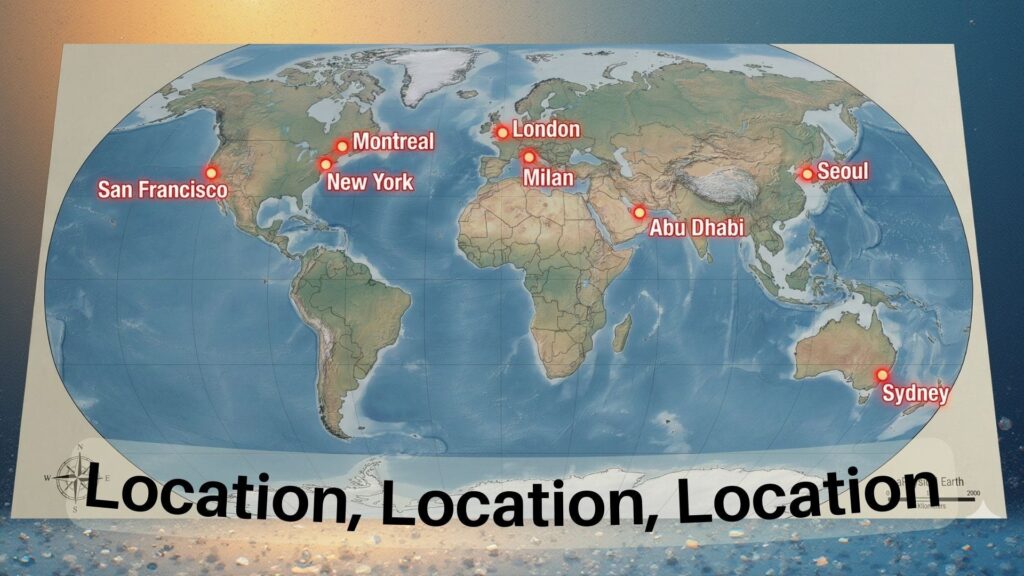
For the past 30 years I have been building companies across multiple geographies. Creating plans, founding teams, joining opportunities, raising capital, investing: the full spectrum of entrepreneurial activity, unconstrained by a single location.
Ten years ago Network Society Labs, a global network of blockchain consulting groups, operated offices in San Francisco, Buenos Aires, London, Malta, Johannesburg, and Sydney. We eventually wound it down, but coordinating teams across six cities and four continents fundamentally shaped how I think about distributed work.
That rhythm continues today. Traveling internationally allows me to plan deliberately while also creating space for serendipity. By signaling where I will be, and not where I permanently reside, I create a coordination surface for encounters that would never be scheduled but can easily happen. Three weeks ago I was in New York, the week after in Italy, last week in Abu Dhabi, and next week in Sydney.

The platforms where we interact rarely provide a good way to express this reality. From time to time, I indicate the center of gravity of my activities rather than a fixed location, reflecting how my work actually unfolds.
It is therefore meaningful that I recently updated my location on LinkedIn, X, and elsewhere from New York to Abu Dhabi, as I joined Al Liwan, headquartered there. Al Liwan also operates from Riyadh, London, New York, and Tel Aviv, with a deliberately global posture from day one. Going forward, I expect to spend roughly one week per month in Abu Dhabi, and I have already had the opportunity to work in person with teams across our global offices.
I am eager to strengthen a culture of written communication and a sophisticated use of collaborative tools, enabling our global team to work effectively even when we are not in the same physical location. A seemingly minor change (having the Abu Dhabi team split between two office buildings separated by a ten-minute commute) shifted behavior from “let’s meet in the room” to “let’s meet online.” Physical constraints, unexpectedly, became a catalyst for better digital coordination.
Collaborating online is now supported by a rich and rapidly evolving set of tools, increasingly supercharged by AI. But tools alone are insufficient. They amplify what already exists. When relationships are real, teams can focus on building networks of trust. Tools scale coordination; trust scales judgment. Without the latter, the former merely accelerates noise.