

 IT
IT
 HU
HU
 AR
AR
General
We Are About to Colonize the Solar System: The Transformation We Are Living Through
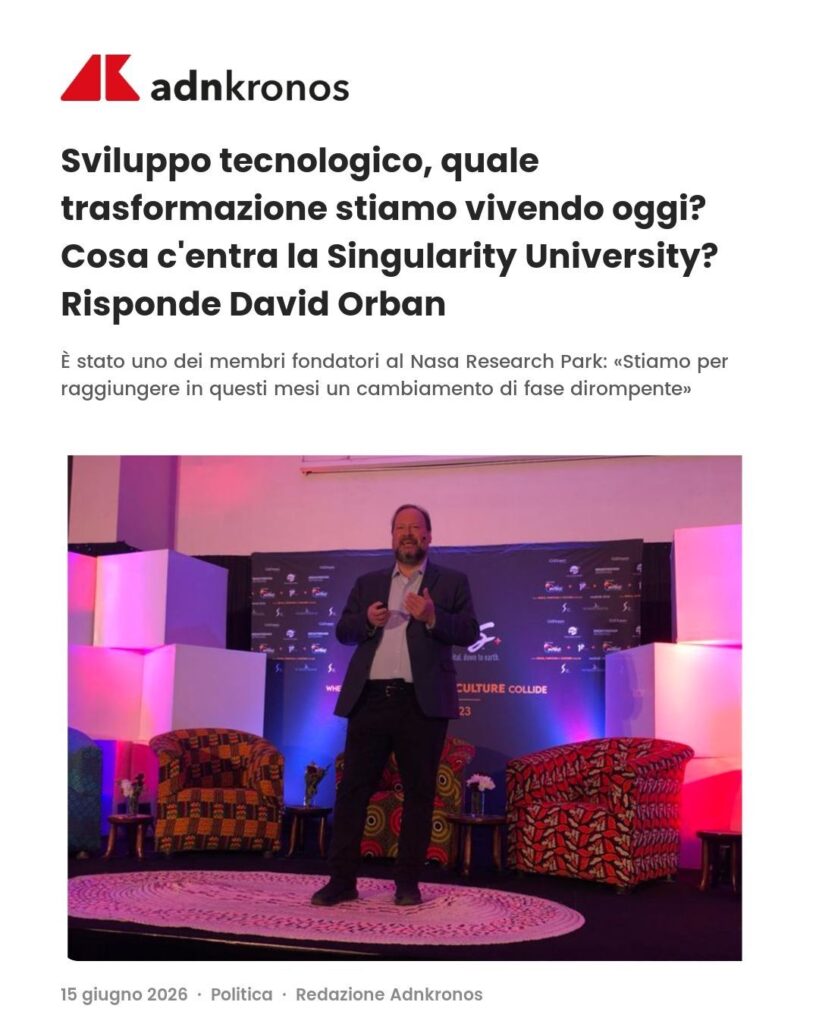
Roberta Lanzara interviewed me for the Italian news agency Adnkronos about the technological transformation we are living through and about Singularity University. The agency’s article, with the outlet’s own editorial framing, is here: read it on Adnkronos. What follows is the interview itself, the full version of our conversation. My thanks to Roberta and the newsroom.
What is the question we should be asking?
I’d draw two distinctions. The first: it is absolutely true that we are facing a series of phenomena that unfold simultaneously and intertwine, and therefore form a complex picture that, unless you have the patience to dig in — or the good fortune of having someone interpret it for you, which is precisely the work of journalists — is hard to grasp. The second: these phenomena can be read in complementary, different ways; there is no single way to interpret them. I am used to reading them through the lens of technological change, which has implications for social organization and which then expresses itself in political movements, forms of government, executive decisions. I generally don’t comment on the contingent aspects of a particular government or party, because I look at phenomena in their longer waves.
So, what is the question we should ask ourselves? In my view one of the fundamental questions today is this: whether our moment is as singular as it seems. We are constantly taught to distrust that impression — across history eras resemble one another, we shouldn’t think there is a special nation or a special civilization; we are accustomed to a relativism that tends to put everything on the same plane. And so we are led to believe that the impression that our moment is special in the history of the world is a mistaken impression. Simply asking the question — is this impression true or false? — is already a valid starting point. My answer is that the impression is not mistaken: this historical moment really is singular, it is a fundamental transformation, almost a phase change in the history of human civilization — and possibly beyond.
What do you mean by “possibly beyond”?
It means that the decisions we make now don’t affect only the next few generations, as happened in the great geographical explorations. The Chinese emperor recalled his fleet — ships ten times larger than Columbus’s — and today we don’t speak Chinese because we weren’t colonized by them: those decisions shaped hundreds or thousands of years of the future. The decisions we make today reach further: they reach beyond the future of the Earth itself, they affect the future of the Solar System and potentially of the rest of the universe. The reason is that, thanks to the technological development we’ve reached, we are about to colonize the Solar System, and after that we certainly won’t stop. At the moment we have no trace of other technological civilizations: if it is true that we are alone, then the task and the responsibility of awakening the universe — of turning dead matter into life, thought, ambition and curiosity — is an even greater responsibility. This is the largest frame, one that spans time and space at their fullest extent.
If this moment is so unique, is it possible to make decisions wisely, avoiding potentially fatal mistakes? And what is the method for doing so?
Did the methods we used in the past work? Where did they, where didn’t they, and how can we improve them? From this comes the value of knowledge, of scientific research, and of applying that research in tools, engineering and technology that improve people’s daily lives.
People are naturally curious — they have to be, in order to test what surrounds them — but they also, very naturally and biologically, fear extreme change, because they have no certainty of being able to adapt to it. Today many people fear technology because they realize it is what is catalyzing very large changes in the world. They fall, however, into an extreme: a natural fear that, through curiosity, could lead to experimentation and knowledge instead leads them to reject technology. They imagine they are incapable of doing that deeper work, or that they have no access to the tools needed to process the implications of change, and so they imagine that by rejecting technology they can regain the stability they long for — whether relational or economic.
A new graduate — or worse, a new high-school graduate — says today: I’m about to enroll in university to spend four years studying things that were decided forty years ago, and when I graduate, how prepared will I be for a world that in the meantime has advanced not by five years, but by the equivalent of fifty years in terms of technological change? The recipe of the past — study hard, get your degree, and then you’ll find work and economic stability — is today an illusion, and the fear of the graduate who reasons this way is entirely reasonable. But the response of many — let’s not use artificial intelligence, let’s not embrace change, let’s try to slow down — is an illusory response, because it assumes it can bring back the previous stability. It cannot: not technologically and not economically. In a world of global economy and competition, a nation that chooses to slow down reduces itself to poverty, rather than regaining the stability of the past.
In my view it is very important to convince as many people as possible that they are not powerless in the face of technological change. On the contrary: today more than ever the barriers to entry for experimenting and understanding what is happening are extremely low. A simple example that not many grasp: we all love to complain about inequality, about how unjust it is that billionaires have their billions, deluding ourselves that if we took the billions from them we would have them. But to understand how equal we actually are in opportunity, it’s enough to realize that billionaires do not have a better smartphone than anyone else. The base of opportunity that owning a smartphone represents today is the same for everyone: the difference is not in the amount of money, it’s in the imagination with which you use the tools technology puts at your disposal.
That is a very optimistic point of view.
It’s a mix of choice and disposition. But my appeal is to try to be more optimistic, because the optimist, when right, makes things better for everyone; whereas the pessimist, when right, makes things worse for everyone. So if we’re going to be right, we might as well be optimists. It’s also something of a self-fulfilling prophecy: if I’m optimistic and I believe I can take risks to reach a goal, and I’m right, those risks will have generated returns and it will have been worth it. If I’m a pessimist and I say “I won’t even try, I’ll never make it,” I’ll be just as right — and I’ll have accomplished nothing.
This attitude of acting, of designing a future we want to bring about, is made possible today partly by technology, which lets ideas travel at enormous speed and lets the best ideas attract attention and enthusiasm from others who want to join them; but it is also made possible by the evolution of the social contract. Instead of ending up, as in the Middle Ages, in debtors’ prison, a person who takes entrepreneurial risks and doesn’t make it can still feel like an integral part of society: they are not cast out, punished or cursed. In certain places, like Silicon Valley, people recognize that the failure of a project is a natural part of the search for what actually works. Google was not the first search engine, Facebook was not the first social network: many things emerged through experimentation that was necessary and natural.
So what is the “technological singularity”?
The technological singularity, and the singularity of the change we are living through today, stem from the growth in the power of our computers and of the algorithms that run on them, in particular applications we call artificial intelligence. And AI applications are not like the others, because they promise not only to be advanced, but to have a capacity for self-improvement. Let me give you a concrete example: the audio recording of this very conversation is not a mere recording — it is being transcribed by artificial intelligence in real time. The transcription that journalists labored over ten or twenty years ago is now automatic, instantaneous and extremely reliable. That is an extraordinary feat, and there are others like it across countless fields. But the point we are about to reach is a different one: not only can we use the skill of programmers to build these applications — the applications themselves will be able to build their own future versions. This process of recursive improvement, which we are about to reach literally in these very months, is that disruptive phase change we can label with the expression “technological singularity.”
A caveat, though: “singularity” here is an analogy, a mere analogy, and it can even be misleading. Some take the physical analogy — linking the technological singularity to the singularity inside black holes — but that isn’t particularly useful, especially in popularization, because it explains one complicated and little-known thing with another complicated and little-known thing. If I tell someone who isn’t a physicist “the technological singularity is like the singularity in black holes predicted by Einstein’s general relativity,” that person nods and has understood nothing — and rightly so. The real reason it’s called that is different: it represents a barrier, a veil, a phase change. The things that happen before and the things that happen after are very different. And our ability to predict what happens after is limited: the mechanisms of the after, being different from those of the before, carry greater uncertainty, and so it is reasonable to ask which rules will still hold and which will be radically different.
What are the consequences, especially for work? And who benefits — cui prodest?
A couple of examples to give the measure. In the twentieth century we are used to average economic growth of 2–3% per year: when the economy grows less we complain, when it grows more — as in China over the past twenty years — we marvel. But over the preceding thousand years the average was not that: it was a little over 2% per decade. Economic growth increased tenfold in the twentieth century compared with the previous millennium. Now there are projections that, through the impact of artificial intelligence on society, expect far higher economic growth, up to over 100% per year: an economy that doubles every year.
Growth of that order is not simply “more of the same”: it compresses into a few years transformations that historically took generations. On the labor front the real risk is not “the end of work,” but misalignment: you train on programs designed for a static world and find yourself in a world that advances fifty years in five. The tasks that define a profession today get automated, but new ones open up faster than we can name them. The answer is not to shield yourself or to refuse, but to engage: get your hands on the technologies, experiment with them, stay in continuous learning. And here too lies the answer to cui prodest. The factor that makes the difference is not capital — a billionaire doesn’t have a better smartphone than ours — but the imagination with which you use tools that, for the first time in history, almost everyone has access to. Growth can benefit many, but not automatically: who it benefits depends on the choices, including political ones, we make now, on how we distribute the productivity gains and how we govern the transition. Refusing technology is the only way to lose with certainty; taking part in it is the condition, not the guarantee, for the benefit to be widespread.
Will the forecasts be of great economic growth for Italy too?
Italy was a desperately poor nation at the start of the twentieth century, and today it is not a poor nation. It likes to feel sorry for itself, it likes to claim it’s worth little — but there are millions of people trying to immigrate to Italy, and that is a concrete measure of the fact that Italy is a desirable destination. As an optimist, I imagine Italy will not choose to opt out of this mechanism. An industrial nation like Italy would practically have to commit economic suicide to force itself out of this change: it would have to declare an autarky isolated from the rest of the world, something only North Korea does today. If instead it remains part of the world economy, it will naturally come to benefit from the changes ahead. And whether that productivity increase is 100% or 50% per year matters little: it is a new economic paradigm made possible by technological change, as different — and more — as the Middle Ages of the year 1200 are from the twentieth century. Except that, instead of happening over eight hundred years, it happens over five.
What will concretely happen in people’s lives in the coming years?
To project it, it’s worth remembering how much has already changed. In the 1920s, if someone took a ship from Italy to America, it was forever: if they were lucky they sent a letter, which arrived a few months later; whoever received it could barely read; a few months after that came the reply. In the 1950s and 1960s intercontinental phone calls began: ten minutes could cost a week’s wages. Today we talk for hours with anyone in the world at no extra cost. Those are changes that have already happened — and the ones coming will be just as radical.
There will be cures for diseases that are incurable today: Alzheimer’s, diabetes. An incredible scientific result came out just a few days ago: a single injection that brings about complete remission of pancreatic cancer, one of the deadliest tumors, with a median survival of just a few months from diagnosis — a literal death sentence. Today a complete cure is in trials, with a single injection, with total remission. We genuinely have the possibility of successfully confronting, one after another, the causes of death that characterized the human condition — and so that condition will change, including in how we perceive the possibility of designing a healthy life decades longer.
Another reason the human condition will change radically is that — at first a few, then an ever-growing number of people — will voluntarily choose an interface with computers and with artificial intelligences far better than the current one. Today we use ChatGPT with the keyboard or by voice, but the rate of information exchange is low: we humans on one side and the AIs on the other are straining to understand each other better, faster, more deeply. Brain–computer interfaces are being built that today are beginning to help people struck by serious illnesses: first of all people with ALS, completely paralyzed, who can move only their eyes but are perfectly conscious inside their bodies. Interfaces are now being implanted that let them use a computer, compose with their thoughts sentences that the computer speaks in their own voice — synthesized from the analysis of past recordings — coming back into contact with their families. And these interfaces are only the beginning: from helping people with disabilities they will spread to people who want to use them to increase the degrees of freedom with which they design their own lives. People who are less enthusiastic, less inclined to novelty, will see this as something hard to accept.
What is the timeframe for this phase change?
The trials on people with disabilities are already happening now. For the further step it is partly a matter of regulation — of when it will be allowed — and then the adventurous ones who say “I’ll try it right away” will be there in a flash. I myself, in a very theatrical way that has nothing to do with what’s possible today, almost fifteen years ago implanted a chip in my hand that lets me communicate with computers where the setup exists: opening doors, using photocopiers, exchanging contact information, paying for coffee. It’s a little grain of rice you can feel under the skin, when someone wants to check that there really is something there. When I talk about it at conferences, a large share of people are curious, but another significant share are utterly horrified.
To answer the question of when it will spread: within five years the first adventurous ones will be able to do it, and within ten years it will be something for which many people will ask themselves not only whether to do it, but how they could do without it — a bit like how today few people can afford not to have a mobile phone. This new kind of interface with artificial intelligences, together with biological improvements, advances in medicine, and a quality of life in a body that stays young, active and energetic for decades, will be the basis of what, looking back, will make us say: it was right to call that period of transition the “technological singularity,” because today we live in a very, very different world.
With this chip in your hand, what can you actually do?
It depends on what’s in the environment. A bit like in Mark Twain’s wonderful novel A Connecticut Yankee in King Arthur’s Court: the protagonist travels back in time and has to reinvent everything. If I had a mobile phone without the infrastructure towers that enable calls, it would be of little use to me — and the chip too needs an equipped environment. In Stockholm, in particular, there’s a building called Epicenter fully equipped to be used through the chip: the photocopier, exchanging contact data, paying for coffee, opening doors. But I can use it at home too; it’s just that, to pay at a café, the phone is more convenient. When I implanted it, fifteen years ago, it was something very exotic — but the technology is the same as the contactless payments that phones didn’t have back then and that we all use today. The form it takes doesn’t matter: what matters is the function it delivers, the benefit it gives. That’s why the analogy is useful: the brain–computer interface implants that few people have today, as they improve and become ever easier and richer in features, will be adopted by billions of people.
Let’s turn to what is called the “university of the singularity.” In what form does it exist in Italy?
Just as we don’t translate “Facebook” into “face-book,” it’s useful to keep the expression in English: it’s called Singularity University, it’s a proper name, not a phrase to be translated. Since I have family and a home in Italy, it was natural to bring this initiative first to Europe and then to Italy, where today it lives through an organization of former students and supporters: a non-profit association called Axelera, which is also the Italian chapter of Singularity University and organizes outreach events. Over the years we’ve held more than sixty events to spread knowledge of exponential technologies and of the radical change we are seeing in the world.
People often mention a Singularity Summit at Stanford in 2006, organized by Peter Thiel, before the university was founded in 2008. Is that right?
Let’s reconstruct the sequence from the beginning, because precision matters here. The starting point is the publication, at NASA, of a scientific paper by Vernor Vinge titled The Coming Technological Singularity, in 1993: a short paper, available online, that articulates what we’ve been discussing. In 2005 the book The Singularity Is Near was published, written by Ray Kurzweil. It was in the wake of that book that, in the following years, the Singularity Summit was organized. The first edition was held at Stanford University, in 2006, and it was organized and funded by MIRI, the Machine Intelligence Research Institute; MIRI, in turn, was funded by Peter Thiel. So Thiel gave money for it to be organized, but he did not organize it: the fact that he was there is, as far as Singularity University is concerned, irrelevant. In those years, if you asked experts when this phase change — artificial intelligence capable of recursively improving itself — would happen, the answers ranged from “in thirty years” to “in a hundred years,” “in a thousand years,” or “never”: a statistical distribution so wide as to be almost meaningless. There was no consensus, and that’s why a conference trying to figure out whether consensus could be reached was useful.
Singularity University was then founded, independently, in 2008, by Peter Diamandis and Ray Kurzweil; I was part of the group that designed it at NASA’s research center, and I am an Advisor and a member of the faculty. Our goal was not only scientific and technological, but also to catalyze economic and entrepreneurial thinking: to prepare a new generation to take advantage of the opportunities these changes would bring. To be clear, since the two share a word: “Singularity Summit” and “Singularity University” have nothing to do with one another, and Peter Thiel does not figure in the history, the practice, or the activities of Singularity University.
Why did this great attention come precisely from NASA, and how did the collaboration with Google arise?
The American space agency has always been attentive to new technologies, by definition. Google is located across the street from NASA’s Ames research center, and Google’s founders had already leased a couple of runways for their own airplanes: there was already a mutual acquaintance between Google and NASA. In particular, the director of the research center at the time, Pete Worden, was very open to outside collaborations, and so, when the possibility of creating Singularity University emerged, he gladly offered to host it.
What advice would you give today to a young student, in engineering or physics, for example?
To get their hands dirty in the most direct way possible with advanced technologies, which have no barriers to entry or very few. Within the university structures, accompanied by the most effervescent professors, the ones open to novelty — but, if necessary, also outside them. And to realize that they can build a path that doesn’t necessarily have to become entrepreneurial: not everyone wants to take on the risk that starting a company entails. A path, though, that lets them step out of the trivializing template of the CV, and come into contact with job opportunities through a concrete demonstration of what they can do — being so brilliant that companies can’t afford not to hire them. Today anyone can put up a website where they recount their passions and their projects, and when looking for work aim at that, not at the European-format CV that reduces everyone to a form that says nothing about real ability.
And when I say “outside them,” I mean very concrete things. An electronics engineer can buy components to build projects to show. There are more and more robotic laboratories that, for very little money, run experiments for you: you open your computer, set up what you want done, and on the other side of the world — literally — robots move the flasks and mix the reagents to give you the result. For aerospace engineering a fantastic example is nanosatellites, the so-called CubeSats: satellites one liter in volume, ten centimeters per side, that entire high-school classes design and have carried into orbit in the nooks of rockets, getting hands-on experience of what it means to design, put into orbit, gather and process signals. Or the ESA, the European Space Agency, which in Rome runs a summer school with cash prizes, open to anyone, for the use of the data it makes freely available from its Earth-observation satellites — satellites that cost billions — for applications in agriculture, urban planning and many other fields. There too it’s only a matter of getting involved: there are literally no barriers to approaching the field.
One last question. You will surely have read Pope Leo XIV’s encyclical “Magnifica Humanitas” on artificial intelligence. There are circles close to those who contributed to its writing who are urging Europe to set up a center as an alternative to Singularity University and its supposed transhumanism, aiming instead for a kind of neo-humanism. What do you think? And first: is it correct, looking at Singularity University, to speak of transhumanism?
There are three distinct aspects. On the first: I was president of the World Transhumanist Association, and Ray Kurzweil is a transhumanist, so within Singularity University that current is certainly present. But they are two different things: Singularity University looks very much at the entrepreneurial opportunities that technology represents, whereas transhumanism is a philosophical current. They influence each other, but neither is defining for the other.
The second aspect is Europe’s desire — reasonable, but poorly substantiated by the facts — not to be a passive subject vis-à-vis the Americans or even the Chinese in this artificial-intelligence revolution, and therefore to achieve autonomous sovereignty. But the premises simply aren’t there, because the necessary investments are two or three orders of magnitude larger than what Europe is putting on the table. Without those investments, principally in energy and data centers, it is illusory to speak of Europe’s autonomous sovereignty in artificial intelligence. When the leading industrial country of Europe, Germany, autonomously chooses energy poverty by shutting down its nuclear plants, only to be surprised at depending on imports of Russian gas, it’s clear it cannot aim to double or more the energy investments that AI data centers require. The only European nation that can think of doing so is France, precisely because of its energy autonomy — and it’s no coincidence that one of the most important AI labs in the world is French: not Italian, not German, not Dutch. But we are still far from being able to give substance to this desire for autonomous sovereignty.
The third aspect is the papal encyclical, which — without going too deeply into the merits — I find a bit paradoxical: it calls on us not to entrust ourselves to a single moral source, pointing the finger at artificial intelligence, after having claimed for two thousand years to be the only moral source. It seems to me a perfect case of the pot calling the kettle black. I know the Pope consulted several experts, and one of them is one of the founders of Anthropic — and thank goodness. But the Church risks repeating the mistake it made with Galileo: by condemning change, progress, scientific and technological knowledge, it took five hundred years to recognize its own error and to officially apologize for the condemnation of Galileo — fortunately without having burned him, as it did Giordano Bruno. If the Church persists in condemning technology and progress in the case of artificial intelligence as well, it may find itself in the same Galilean condition of error, and will have to apologize for not having understood the benefits this will bring to humanity.
Interview by Roberta Lanzara, originally published by Adnkronos on 15 June 2026.